Reviewing Babylon-Pro 5.0, a web software product with content and an interface in 12 languages, definitely called for a collaborative effort. Hence, the following review, which combines the reviewing efforts of several professional translators.
What is Babylon-Pro 5.0? What does it do? Does it work, and perhaps most importantly, does it work for professional translators? These are the questions this review attempts to answer.
Babylon-Pro 5.0 is a single click, interactive, dictionary access and search engine for PCs only. Babylon-Pro 5.0, with selected dictionary access, can be downloaded for off-line use. It can also be used online through the Babylon.com website, which provides a few extra cool functions and glossary access. The software is packaged as a link in an e-mail message, with no lengthy instructions, other than “Click.” Once Babylon-Pro 5.0 is installed on your computer, you can configure it to your preferred specifications, including a user-defined hotkey “click.” Your (customized) Babylon opens as a small window on your desktop, and with a single click on any term, searches for words in the multiple Babylon dictionaries and glossaries you have selected online at Babylon.com, and in any of the premium content dictionaries (PCDs) available for purchase. Babylon then displays the search results in a single window, allowing you to obtain several hits for a single term that are retrieved from the sources you have downloaded, or enabled for use on the Babylon-Pro user interface. See Figure 1 below for a single click search for the term “MP3”. 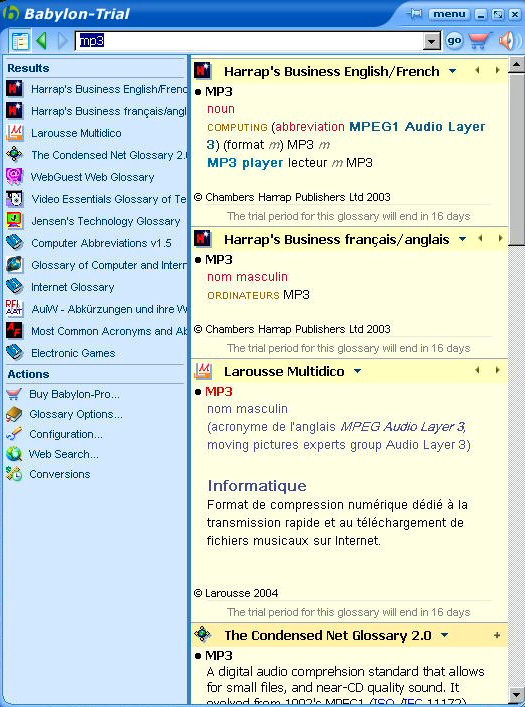
Babylon offers three different dictionary resources covering 12 languages: French, German, Spanish, Italian, Portuguese, Dutch, Russian, Japanese, Chinese (Simplified and Traditional), Swedish, Hebrew, and English. For the nominal price of $49.50, you may download for access, on or off-line, any of the Babylon dictionaries (monodirectional, bi-directional, or monolingual) and free professional or user-created glossaries. For an additional nominal fee, you may download Premium content dictionaries (PCDs), both general purpose and specialized in various monolingual or bilingual combinations. (Check Babylon.com for a current list of available PCDs. See Table 1 at the conclusion of this review for available PCDs in July 2005.)
Beyond single click access to all of these dictionaries and glossaries, you may also download, free of any charge (even the Babylon software charge), a user-friendly program called Babylon Builder. Babylon Builder allows you to create your own glossaries including pictures, other media, and links to your own Web pages. The glossaries that you create, and want to share with other Babylon users, using Babylon Builder, may also be uploaded and submitted to Babylon. There are currently over 1,600 such glossaries, all of which you can cue Babylon to search to produce immediate results on the single Babylon platform.
Finally, Babylon comes with two wonderful extras: “Say it” MS TextToSpeech™, and a conversion tool. “Say it” enables you to hear the pronunciation of English words or phrases in the search box. You may set the “Say it” voice for special effects (male, female, whisper, echo, robot), as well as the language with a pull-down menu, which currently only lists English as an option. The conversion tool, in addition to converting regular units of measurement (such as length, weight, volume and temperature) also includes real time quotes for currencies, updated on a daily basis, and time conversions for any country or per time zone. Compared to standard conversion tools, the Babylon conversion tool is greatly enhanced. The same applies to the “Say it” function, which converts text to speech, hence more than a single word, while affording a few good laughs, with all of the special voice effects and pronunciation of foreign words in English.
This explains Babylon-Pro 5.0 in a nutshell, and what your (customized) Babylon can offer, depending on your specifications in terms of languages and the kind of dictionary and glossary access you download, enable, or purchase. The next questions follow. “Does it work?” and most importantly, considering an already existing 26 million users, “Does it work for professional translators?”
Installing the software via an e-mail link was pleasantly easy for almost everyone on the review team. For two translators, however, a series of interference occurred. One of these involved browser extensions, in particular “Spyware Doctor” which needed to be disabled in order to use Babylon Click with Yahoo! opened in Internet Explorer. Another interference occurred with the use of DDWin, a look-up program that searches multiple Japanese dictionaries. Care also needed to taken when defining the Babylon hotkey “Click” so that it correlated with mouse button definitions. And finally, those who tried using Babylon with Adobe Acrobat discovered, as specified, that Babylon only works with Acrobat Reader. The upside was that Babylon’s technical service proved to be extremely persistent and efficient in tracking down the root cause of any interference problems arising in conjunction with installation. For a modest $8.90, you can subscribe to Babylon’s Annual Maintenance Plan, which will ensure that you are not routed to the FAQ (Frequently Asked Questions) site, even if there is much precedence regarding your particular question. A friendly technician will message you personally, and call you, to help with any of these known interferences, pending their resolution among business partners.
The professional translators who participated in this review agreed that Babylon definitely offers the wonderful advantage of single click access to multiple dictionaries, with hits from multiple sources appearing in a single window. For example, a single click search on the term “snuff” may, depending on your Babylonconfiguration, return results in a single window from 13 different sources, including the Concise Oxford English Dictionary, the Oxford Thesaurus, the Encyclopedia Britannica, translations to French returned from the Babylon dictionaries, explanations from an Australian slang glossary, word anatomy from the Princeton University WordNet, and translations gleaned from a Shakespeare to modern English glossary, etc. This capacity was perceived as terrific on several counts. You do not have to search each of these sources separately, depending on the kind of information you are seeking. Your desktop is uncluttered, and so is your computer’s memory. You do not have to swap CDs in your CD-ROM drive, and the speed of it all is simply mindboggling, not to mention access to resources that you wouldn’t have even thought existed!
However, there was also a consensus that despite the abundance of well-known dictionaries and sources available, these resources still needed to be greatly expanded and enhanced on a continuous basis. Unlike most people working in multilingual environments, professional translators seldom work with more than two languages. However, and perhaps paradoxically, the dictionary needs of professional translators are simply gargantuan, aforciori when as many as 12 languages are involved. In Japanese, for example, Babylon offers two dictionaries from the Taishukan publisher. However, the unavailability of access to another industry standards, such as the Kenkyusha Japanese<>English Dictionaries, was noted. For Russian, Hebrew, and Chinese, there are no PCDs, and the absence of access to the New Big Russian-English Dictionary, for example, or to the Rav Milim monolingual dictionary and Ectaco electronic bilingual dictionary for Hebrew, was noted. Similarly, in French, one could bemoan the absence of access to the Robert & Collins, or the Harraps’ Pro, which includes the Harraps’ Business Dictionary offered via Babylon. And the same would hold true for Spanish, for which the current PCDs cover non-English-language combinations (Michaelis Portuguese-Spanish, Larousse French-Spanish, and Larousse German-Spanish).
Still, assuming that all of the aforementioned general language PCDs were included, professional translators in the field of medicine, for example, would still need access to medical dictionaries, and the same would hold true for the legal or engineering domains. Thus, while Babylon offers a model that correlates perfectly and beautifully with translators’ needs for multiple megasources of definitions, translation, and word anatomies, with the added speed and convenience of single click access and single platform lists of hits, it was also perceived that the model was not yet supplying access to enough reliable resources, both in terms of breadth and depth. That is, professional translators would need access to a still wider selection of standard dictionaries, with more specialized resources before they would consider abandoning their current lengthier search functions, more expensive installations or existing alternative web resources. As one of the experienced reviewers pointed out in reference to the Japanese content:
“The quality/usefulness of a lookup tool like Babylon Pro ultimately boils down to the quality of the available dictionaries and ease of use. I would give Babylon Pro very high marks for ease of use and its interface, but the dictionaries are nothing to get excited about.”
Beyond issues of expanding the PCD offer, the question of enhancement was also raised. Regarding the Babylon-devised dictionaries, a small list of terms used for testing revealed that translations for compounds (e.g., “health professional”) could not be retrieved. Additionally, at least one professional translator felt that any specialized glossary-type resource would have to be referenced, or in some way explicitly evaluated or recommended, per industry standards, to be considered reliable enough for consultation. In other words, information gleaned from many of the 1,600 Babylon community user glossaries could be simply ignored as potentially unreliable. Extreme as this position appeared, it also served to highlight the special needs of professional translators, who often work on material (for example, medical instrumentation or machine specifications), the meaning of which subsumes serious life and death situations, and for which there simply is no permissible margin of error. As the University of Chicago, Graham School Translation Studies mantra goes, with no tongue in cheek:
“Misunderstanding the nuances between different languages can be very amusing. And expensive. And potentially dangerous.”
Thus, the enthusiasm and hesitancies generated by Babylon at first glance may perhaps be tempered and better understood, once put into the perspective of translators-at-work.
Despite this “no nonsense” criticism of the program, only one translator of the review team would not use, or recommend, the program. I’d like to conclude this review with a couple possible explanations.
The first concerns Babylon Ltd., the company located in Israel, where the product is immensely successful, that is masterminding this product. Even if Babylon was initially designed with users other than professional translators in mind, the model of the product appears extraordinarily compatible with a translator’s needs: one click access to multiple dictionary and glossary resources for translation. Similarly, none of the shortcomings in terms of more access to a wider, more specialized, and more certified set of resources appeared in any way outside the realm of possibilities, or incompatible with the company’s plans. In fact, assurances were given that expansion of the PCD offer was scheduled, as early as the summer of 2005 for Spanish. And finally, Babylon Ltd. negotiates PCD prices directly with the publishers (on average about 10% lower than what you would pay via another source of supply.)
The second explanation that I would venture for everyone’s enthusiasm, again despite the aforementioned criticism, is that this is a really super friendly little turbo program that fits smugly on your desktop, bringing with it a glimpse of the next generation of MP3-style multiple and selective electronic dictionary resources, beyond CDs. (See the June 2005 ATA Chronicle review of WordFinder). Babylon.com is also willing to host the sharing of glossaries created by ATA members (in the tradition of Termium™), to be posted on its website in a special ATA folder. And the Babylon model of a single platform, dictionary look-up tool, is certainly open-ended enough to potentially accommodate every professional translator’s specific dictionary needs.
Try Babylon-Pro 5.0! You will enjoy it! And, as another member of the review team has put it: “You may risk not being able to live without it!”